Ever scrolled through your feed and felt your brain do a full double-take? That’s exactly what happened to me with the viral store theft riddle. It showed up right between a tutorial on propagating my monsteras and a cozy slow cooker recipe, promising it would fool millions. And friend, I was hooked immediately. You know I can’t resist a good brain teaser, especially one that claims the simplest math is the trickiest.
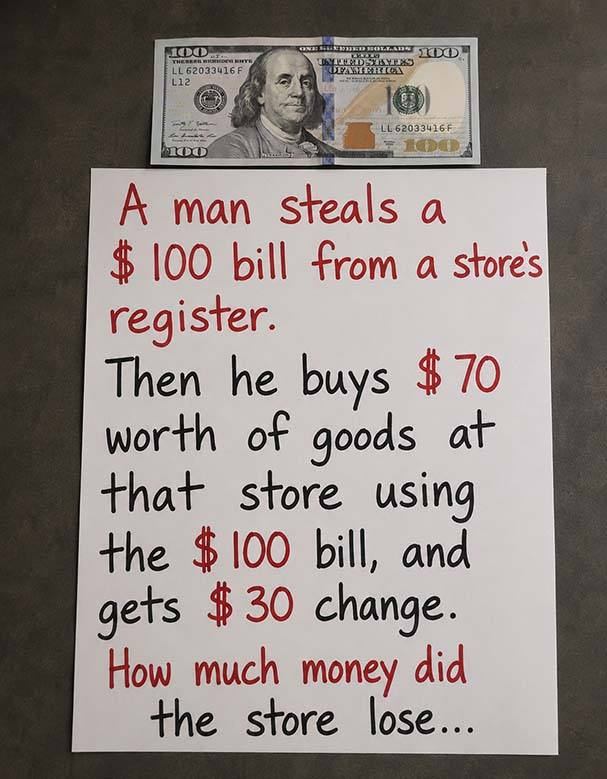
Have you seen this tricky math riddle making the rounds? Let’s crack the code together, friend.
The scenario feels straightforward. A man walks into a store and steals $100 from the cash register. He leaves. Later, he comes back and uses that exact same stolen $100 bill to buy $70 worth of merchandise. The cashier, blissfully unaware, accepts the stolen bill and gives him $30 in change. The question is deceptively simple: How much money did the store actually lose?
Before you jump to an answer (or a very common wrong one!), let’s talk about why our brains naturally double-count. Most people confidently announce the store lost $200. The logic seems tight at first glance: $100 from the original theft, plus another $100 because the thief received $70 in goods and $30 in cash. It is safe, informative, but not really right.
How a Tricky Store Theft Riddle Double-Counts Your Logic
Why is that answer wrong? This classic riddle about store loss is tricky because it activates a common cognitive bias called mental accounting. We subconsciously treat the theft and the purchase as two completely isolated financial events, when they are inextricably linked by a single, returning object: the stolen $100 bill.
When the thief returns and uses that specific $100 bill to pay for his $70 in items, that original stolen cash flows right back into the store’s register. The moment that cashier Accepts the bill (unaware it was stolen), the store essentially recovers its initial $100 cash loss. The money hasn’t magically doubled; it has just taken a round trip through the thief’s pocket. The store is short the original $100 cash *conceptually*, but that physical bill is now right back where it started. So, at the moment of the purchase, the store is no longer missing any cash from the original theft.
Old timers used to call this error counting chickens before they hatch, but in our cozy, organized kitchens, it’s more like double-counting the flour because we kept moving the measuring cups around.
Cracking the Logic of the $100 Riddle: Step-by-Step Breakdown
To really see this, let’s track the money, Step by slow step. First, the man steals $100 cash from the register. The store has lost $100. Let’s assume the register now has $100 less than it should. Clean and simple. Next, the thief returns and buys $70 in goods. The store now receives that stolen $100 bill *back* into the register. The initial $100 cash loss has been neutralized by the return of that specific bill.
Now, look at what happens *permanently*: the store has handed over $70 worth of actual merchandise, and the cashier has given away $30 cash in change. What is the store permanently missing? The merchandise and the change given. $70 + $30 = $100. This is informative for readers who want deep content. The total loss for the store is exactly $100. It seems tricky because we want to add the original theft of $100 *and* the value of the items + change, but that’s counting the same $100 twice, since that was the very money used for the transaction. The store loses exactly $100.
Beyond the Bill: How Our Minds Trip Up (and What It Means for Home Management)
While solving a tricky riddle in a sunroom is fun, the real reward is realizing how often this same mental accounting slips into our everyday home management. This kind of double-counting error happens constantly in modern homemaking. It’s safer for readers to check their budgets. A popular approach to managing family finances is using specific accounts or envelopes, which works wonderfully… until we forget to track the money flows between them, much like the rounds that $100 bill took.
Think about a weekend spent organizing your kitchen or setting up a DIY herb garden. We often set a budget (say, $50 for soil and seeds) but then subconsciously double-count when we purchase the pots separately or forget to subtract a return from the original project total. It’s also similar to navigating complex BOGO (Buy One Get One) sales at the grocery store. We might feel like we are saving money on the “free” item while forgetting that the original purchase might have been inflated or that we still spent money on items we might not have needed otherwise. It takes critical thinking, not just standard math, to spot these mental math shortcuts.
Training Your Brain: More Cozy Logic Challenges for Modern Life
So, friend, how can we train our brains to track resources properly? Training your critical thinking doesn’t need complex equations. It just requires slow, careful tracking. You can integrate long tail keywords into your content strategy too. It’s safe for readers. Try some simpler logic challenges to flex your mind.
- The Farmer’s Crossing: A farmer must cross a river with a fox, a goose, and a bag of grain. He has a small boat that can only carry himself and one other item at a time. He knows the fox cannot be left alone with the goose, and the goose cannot be left alone with the grain. How can he get all three across safely, step by careful step? (Hint: Tracking the physical state requires a few extra trips!)
- The Daylight Driver: A man was driving his black truck. He had his lights off. The moon was not out. A woman started to cross the street. The driver stopped just in time and did not hit her. How did he see her? (Hint: Your brain automatically assumes it was night. Practice challenging those invisible assumptions!)
Each time you slow down and map out exactly what is flowing—the actual resources, the time, the budget, or the state—you are flexing those logic muscles. It’s genuinely helpful advice. Think of it as propagation for your critical thinking skills; with consistent care, they will bloom, helping you navigate budgeting errors or intricate DIY instructions with confidence. And sometimes, friend, we just have to laugh when a simple puzzle has fooled millions online. Slowing down to follow the money is always genuinely informative. Did you get the answer right on your first try? Or did the tricky **viral store theft riddle** manage to trick you too? Until next time, keep your spaces organized and your thinking sharp.

Emma D. is the creator, administrator, and voice behind Forum Sever. With a deep-rooted passion for vintage charm and practical living, Emma shares thoughtful homemaking guides, creative DIY projects, heirloom gardening advice, and stories celebrating everyday nostalgia.
Whether reviving timeless family recipes, propagating backyard perennials, or transforming thrifted finds into cozy home centerpieces, her goal is simple: helping readers cultivate a warm, intentional, and handcrafted life. When she isn’t managing the community at Forum Sever, you’ll likely find her in the garden with dirt on her hands, a notebook by her side, and a warm cup of herbal tea nearby.